


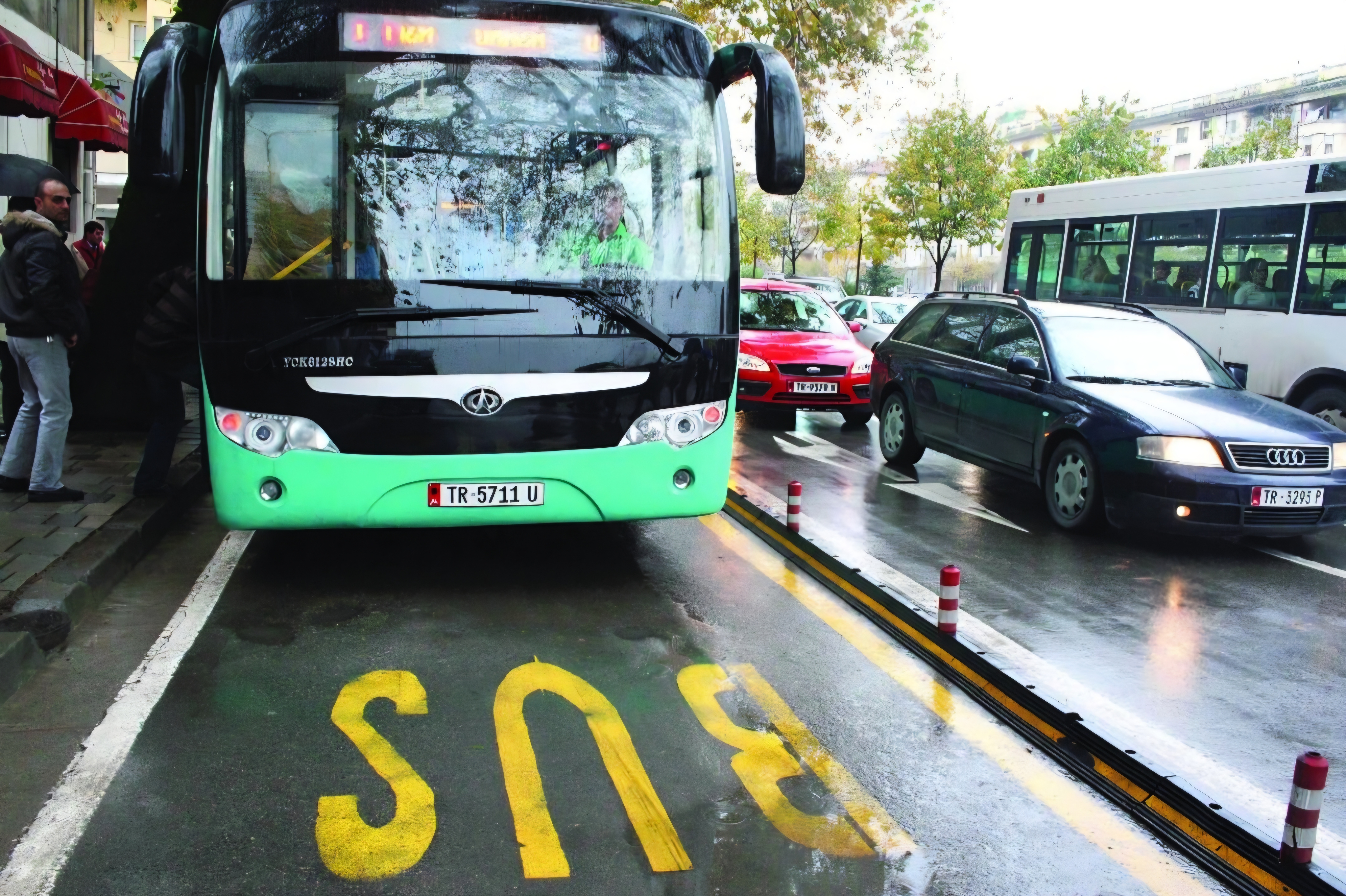
For 14 days now, massive citizen protests have been taking place in Tirana, starting in the afternoon and ending late at night with marches on the streets near the center. The protests are having a domino effect on public transportation in Tirana.
On the one hand, a significant increase in the number of passengers has been observed on some urban lines, especially in the late evening hours. “In 20 years of public transport service, there has never been such a high influx of passengers at 10:00 PM and 11:00 PM. This is the first time I have seen such high attendance. The increase is due to the protests,” claims a ticket for the Qendër–Porcelan line.
Although the number of passengers has increased, traffic jams and frequent route diversions have reduced the number of kilometers traveled by buses.
This situation is expected to directly affect the operators' income, as the performance compensation that operators receive from the Municipality of Tirana is calculated based on the kilometers performed in service. Consequently, the fewer kilometers are covered, the lower the compensation that operators receive.
In Tirana, public service transportation operates with funding from the Tirana municipality through subsidies and financing from private companies.
Kostandin Foni, president of the National Association of Urban Transport, explains that only for urban transport in Tirana, the Municipality provides compensation based on the route of kilometers traveled.
Specifically, according to him, if operators have traveled 94 to 96% of the designated kilometers, they benefit from compensation worth 0.9 lek for each ticket sold.
If they have covered 92 to 94% of the itinerary, the compensation amount is 0.8 lek per ticket. And for 90 to 92% of the itinerary, the compensation amount per ticket is 0.7 lek.
Due to the protests, there have been blockages on many axes of Tirana and for this reason, the itineraries of lines, such as those for the buses of Unazë e Vogël, Tirana e Re, TEG, Kristal, etc., have been forced to be diverted.
In this situation, the National Association of Public Transport has sent a letter to the Municipality requesting that during this period the conditions created by the protests be taken into consideration for evaluating the performance of operators.
"As a result of the protests held in the territory of the Municipality of Tirana, which have led to continuous blockages and diversions of the main road axes. Due to these traffic restrictions, the city's public transport operators have been forced to change the route of the lines, deviate from the approved routes and in many cases have not been able to fully realize the planned kilometers according to the contracts and obligations set by the Municipality of Tirana.
"We request that the kilometers not realized as a result of circumstances be recognized and considered as kilometers realized, for the purpose of evaluating the performance and contractual obligations of the operators," the letter states.
In total, around 50 bus lines operate in the capital, with a fleet of 200 buses.


